By Kyle Ulmer · · 4 min read
The short version: eyeballing and walking the pile are cheap, but they lean on assumptions, and on a number the operator already expects. Phone scanning measures the real surface, but it can't see into a three-sided bin. Fixed LiDAR measures the whole surface from above, on a schedule, with nobody on the material.
Why three-sided bins are hard to measure
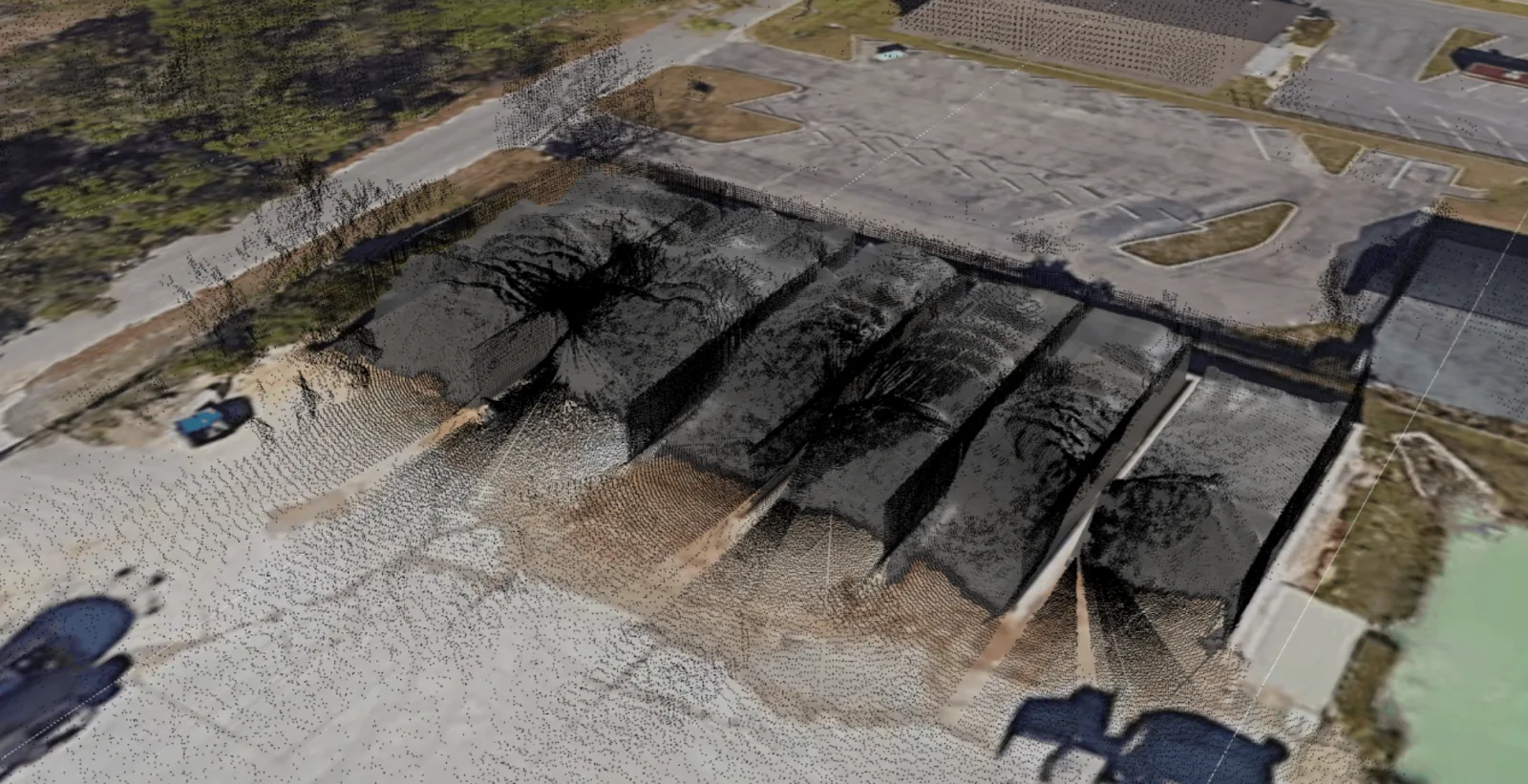
Ready-mix, aggregate and asphalt plants often store material in bins with walls on three sides and an open front for the loader. You can't walk around them, the walls hide the top and back, and the loader is always reshaping the front face. A bin that looks full from the yard often isn't.
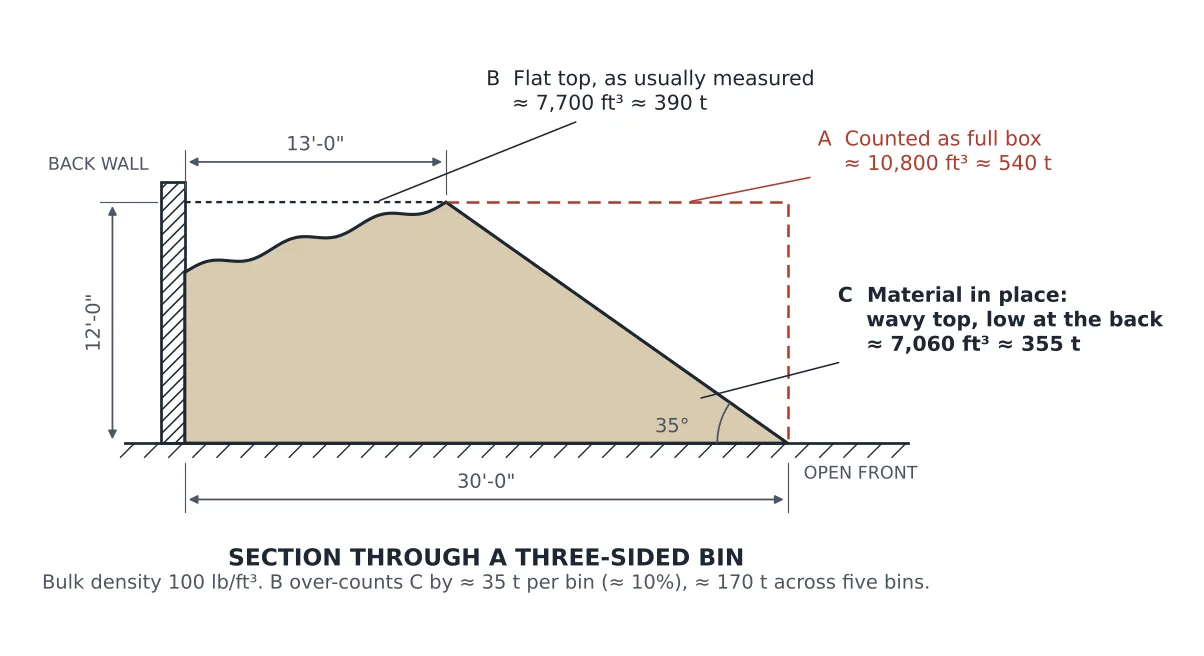
In this 30 × 30 ft bin with 12 ft walls, the material reaches wall height at the front of the pile, so it looks full, and an eyeball call of "full" would say about 540 tons. A hand measurement does better, but not by enough. The top is rarely flat: the loader leaves it wavy, and it often sags toward the back wall, where nobody on the ground can see it. Hand measurements still treat it as flat at wall height, which gives about 390 tons. What's actually there is closer to 355, so the count is about 35 tons high. Across a row of five bins like this, that's about 170 tons on the books that isn't there. At $15 a ton, roughly $2,600, every count.
Then add the "should be" factor. Incoming material is ticketed wet, and some of that water drains or dries out of the bin, so after a month of tickets and theoretical usage the books carry tons that left as water. An operator who knows the book number can easily read the pile a foot or two higher to match it. Over the top of this bin, each extra foot is about 20 tons. Across five bins, that pushes the over-count to roughly 275 to 375 tons, or about $4,000 to $5,600 at $15 a ton, month after month.
The four methods
Eyeball approximation
An operator looks at the bin and calls a number. It's free, instant and fine for "are we running low?" But there's nothing to check, two people give two numbers, and it's the method most pulled toward the expected number. Bins make it worse, because the back wall makes material look fuller than it is.
Walking the pile with a tape and wheel
Someone measures a few dimensions and plugs them into a formula for an assumed shape. It's cheap, but bins break it: there's no perimeter to walk, and wall height says nothing about the face. It's full of judgment calls, it's slow, and climbing piles or walls puts people at risk of falls and engulfment.
iPhone and phone scanning
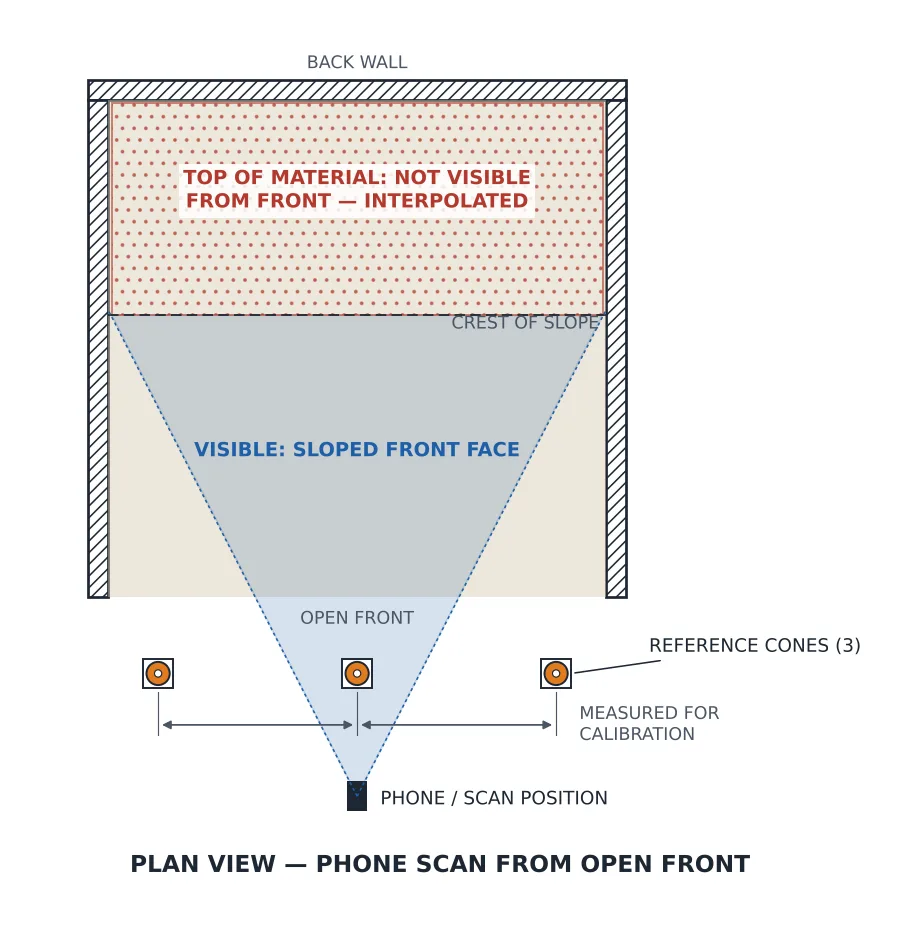
A phone app builds a 3D surface as you walk around the pile. It measures real shape instead of assuming one, and works well on small, free-standing piles. But it doesn't work properly out of the box: each bin has to be measured by hand and reference cones set out in front of the pile so the app can calibrate its scale. And in a three-sided bin, you can only scan from the open front. The phone sees the face, and the software guesses the rest, often by filling in the hidden top flat at the height of the crest. That's the same flat-top assumption as the hand measurement, so the phone scan carries the same error.
Fixed-position LiDAR
A scanning LiDAR sensor mounted above the bins sweeps the whole surface on a schedule, and software calculates the volume in each bin. It sees over the walls, takes the same measurement every time, doesn't know what the number "should be," and keeps a 3D record of every count. The trade-offs are an installation and a clear line of sight.
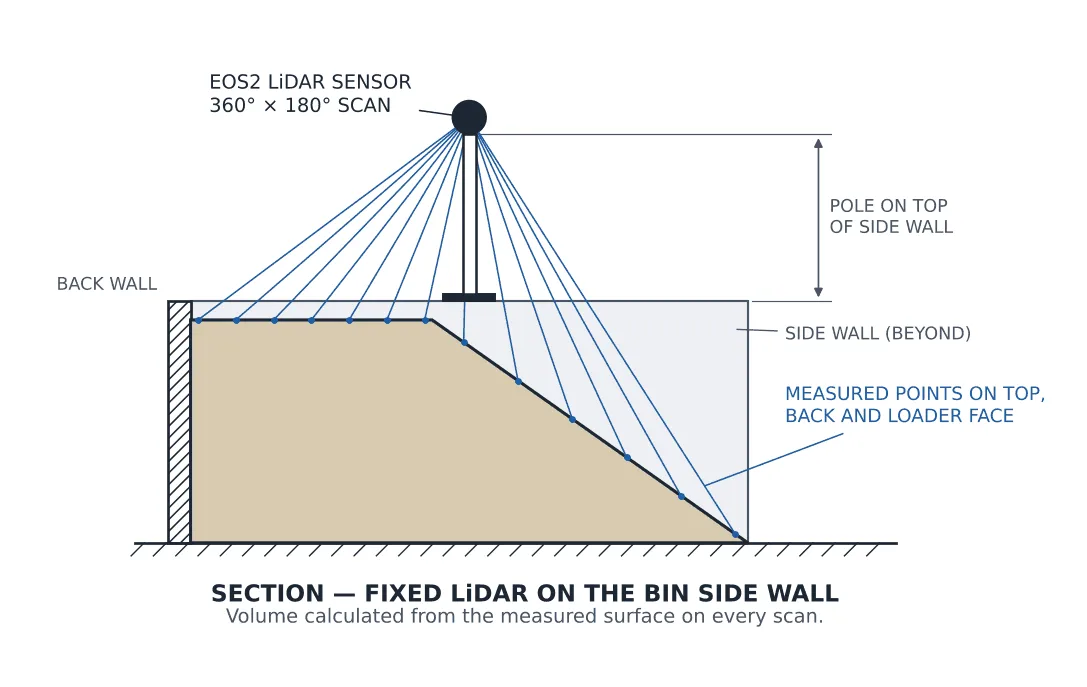
Our EOS2 sensor sweeps a full sphere in about three minutes and runs on solar power. Mounted on the interior wall between two bins, one EOS2 can often gather data for both adjacent bins, so a row of bins needs fewer sensors than bins. Hyperion turns each scan into a quality-checked tonnage for every bin.
Side by side
| Eyeball | Tape and wheel | Phone scan | Fixed LiDAR | |
|---|---|---|---|---|
| Measures | Nothing | A few dimensions | What the phone sees | The full surface |
| Three-sided bins | Poor | Poor | Front face only | Good |
| Swayed by the expected number | Heavily | Yes | A little | No |
| Person near the material | Sometimes | Yes, often on it | Yes | No |
| How often | Anytime | Monthly | Weekly to monthly | Hourly or daily |
| Record you can check | None | A worksheet | A 3D model | A 3D model of every scan |
If the number goes on the books and your material sits in bins, you need a measurement taken from above that nobody can steer. Keep eyeballing for day-to-day calls, and let the sensor set the inventory.
Not sure what fits your site?
Send us a photo or sketch of your bins and piles. We'll tell you straight whether fixed LiDAR makes sense and how many sensors it would take. Ask an engineer.
Comments
No comments yet. Questions and field experience are welcome.
Leave a comment