By Kyle Ulmer · · 6 min read
The short version: LiDAR can only measure what it can see. Anything hidden behind a wall, a loader or the pile itself is a blind spot, and blind spots get filled in by guesswork. The good news is that most of them can be designed out with smart sensor placement, a second vantage point and a little scheduling. Here's what to watch for.
In this article
LiDAR is a line-of-sight sensor
A LiDAR scanner works by firing a laser pulse and timing the bounce. That means every point in a scan is somewhere the laser could reach in a straight line. If something is in the way, the laser hits that instead, and whatever is behind it simply doesn't show up in the point cloud.
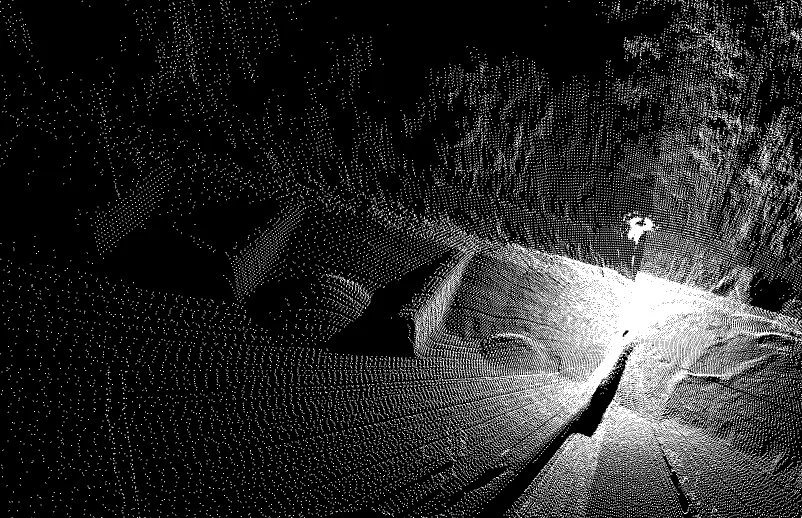
Think of it like a flashlight in a dark room. Everything the beam touches gets measured. Everything in the shadows doesn't. We call those shadows occlusions, and in a stockpile yard or storage building they come from three places: the walls, the equipment and the material itself.
None of this is a flaw in the sensor. Radar, ultrasonic, drones and surveyors with a GPS rover all have their own version of it. The difference with a scan is that you can actually see the shadows in the point cloud, so you know exactly where the data is thin.
Walls in storage bays
Push walls, lock blocks and bay dividers are the classic culprit. If the sensor isn't high enough, a wall casts a shadow on the floor behind it, just like the sun does late in the afternoon. Material stacked right up against the far side of that wall can end up partly or completely out of view.
The geometry is simple similar triangles. With the sensor at height H, a wall of height h and a horizontal distance d from the sensor to the wall, the strip of floor hidden behind the wall is about d × h ÷ (H − h) long.
Quick example
Say you've got an 8 ft bay wall 30 ft from a sensor mounted 20 ft up. The hidden strip behind the wall is 30 × 8 ÷ (20 − 8) = 20 ft. That could be most of the next bay.
Raise the same sensor to 30 ft and the shadow shrinks to 30 × 8 ÷ 22 ≈ 11 ft. Move it so it sits over the bay it's watching and the wall stops being a problem at all.
Loading 3D model…
How to beat it
- Go high. Every foot of height above the wall tops shrinks the shadow. Poles, building trusses and conveyor structures all make good mounts.
- Look down into the bay, not across it. A sensor over the middle of a row of bays sees into all of them. A sensor off to one side sees the near faces and the far walls.
- Cover deep bays from both ends. Hyperion merges scans from several EOS2 sensors into one model, so a second sensor on the opposite side fills in what the first one can't see.
Equipment in the way
Loaders, dump trucks, rail cars, stackers and conveyors all block the laser too. A front-end loader parked in front of a pile can hide a surprising chunk of it, and the laser will happily measure the loader's bucket as if it were material.
Equipment comes in two flavors, and they need different fixes:
- Stuff that moves (loaders, trucks, people). This is mostly a timing problem. Schedule scans for when the yard is quiet, like overnight or between shifts. Hyperion also filters equipment and noise out of each scan, and scanning on a schedule means one bad scan is easy to spot next to its neighbors.
- Stuff that doesn't (conveyors, stackers, columns, hoppers). A conveyor running over a pile casts the same shadow every single scan, so scheduling won't help. This one gets solved at install time by picking mount points that look past or around it, or by adding a sensor on the other side.
Loading 3D model…
The pile hiding itself
This is the sneaky one. Even in a wide open yard with nothing else around, a pile can hide its own back side. The laser comes over the peak and keeps going, and the far slope drops away out of view.
Whether that happens depends on the angle. Bulk materials settle at their own natural slope (the angle of repose), which is often somewhere around 30° to 40° for aggregates. If the sensor's line of sight skimming over the peak is flatter than that slope, the back side is in shadow. If the sensor is looking down more steeply than the slope, it sees right down the back.
A few things make self-occlusion worse:
- Tall, steep conical piles seen from a low mount.
- Several piles in a row, where the front pile hides the base of the one behind it.
- Ridges, craters and loader cuts, which hide little pockets on the side facing away from the sensor.
- Piles that grow over time. A sensor placement that worked fine at half capacity can start missing the back side once the pile gets taller.
Loading 3D model…
How to beat it
- Get above the pile and look down. The steeper the view, the less the pile can hide.
- Plan for the tallest the pile will get, not how it looks the day you install.
- Use a second vantage point for big piles. Two sensors on opposite sides can see both faces, and Hyperion stitches them together.
What happens to the gaps
No real site is perfectly shadow-free, and that's OK. When a scan has a gap, Hyperion fills it in by interpolating the surface from the measured points around it. For a small shadow on a smooth slope, that's a very good estimate.
The key is knowing where it had to fill in. Hyperion's quality checks show which parts of each surface were measured and which were interpolated, and flag scans where too much is missing to trust the number. So instead of a volume that quietly includes a big guess, you get a volume plus a clear picture of how much of it was actually seen. If the same spot is always a gap, that's your cue to add or move a sensor.
A quick placement checklist
- Mount high. Get well above wall tops and the tallest the piles will ever get.
- Look down, not across. Steep viewing angles beat long, flat ones every time.
- Cover big piles and deep bays from two sides. Merged scans fill each other's shadows.
- Map the permanent stuff. Conveyors, stackers and columns cast the same shadow forever, so place sensors around them.
- Scan when the yard is quiet. Scheduled scans dodge most loader and truck traffic.
- Check the gaps. Use the quality view to see what's measured versus filled in, and adjust if one area keeps coming up empty.
Every EOS2 captures a full 360° × 180° sphere, so a single well-placed sensor sees a lot. But "well-placed" is doing a lot of work in that sentence. A few minutes spent thinking about shadows before the poles go up saves a lot of head-scratching later.
Want a second opinion on your layout?
Send us a photo, a site plan or even a sketch of your bays and piles. We'll point out where the shadows are likely to be and suggest where the sensors should go. Our 90-day Hyperion pilot includes help planning sensor placement. Ask an engineer.
Related reading
- LiDAR vs. radar vs. ultrasonic level sensors: which sensor fits which job, and why one reading often isn't enough.
- How LiDAR stockpile measurement works: from laser pulse to point cloud to quality-checked tonnage.
- EOS2 LiDAR sensor: specs, mounting options and pricing.
Comments
No comments yet. Questions and field experience are welcome.
Leave a comment